
Integrations
HubSpot and NetSuite, working off the same numbers. Fully automated, from first deal to final invoice.
Cloudmaven’s eUnify connector links HubSpot to NetSuite natively, so contacts, deals, quotes, and invoices move between sales and finance without spreadsheets, double entry, or a Friday afternoon reconciliation. It’s the same finance-first approach we bring to every ERP engagement.

Why eUnify, in one paragraph
eUnify isn’t a third-party app with its own login and its own copy of your data. It’s a native NetSuite application, built and maintained in-house by the same Cloudmaven team that configures your NetSuite finance architecture, not handed off to a separate integration vendor once the ERP project ends. Your financial data stays inside NetSuite; only the fields you choose to sync ever leave it.
Who this integration is a fit for
Companies running HubSpot and NetSuite side by side, where sales, finance, and marketing still reconcile the same customer by hand.
No shared source of truth Companies running HubSpot for sales and marketing and NetSuite for finance and operations, with nothing connecting them.
Quotes rebuilt by hand Sales teams building quotes in HubSpot that finance then has to re-enter in NetSuite.
RevOps teams A deal marked Closed Won in HubSpot should create the order, not just a reminder task for someone in finance.
Finance teams Invoice status, payment history, and order value visible right on the HubSpot deal or company record.
Marketing teams Real revenue and customer lifetime value data to judge campaign ROI, instead of guessing from form fills.
Multi-subsidiary NetSuite setups HubSpot deals that need to route to the right legal entity automatically.
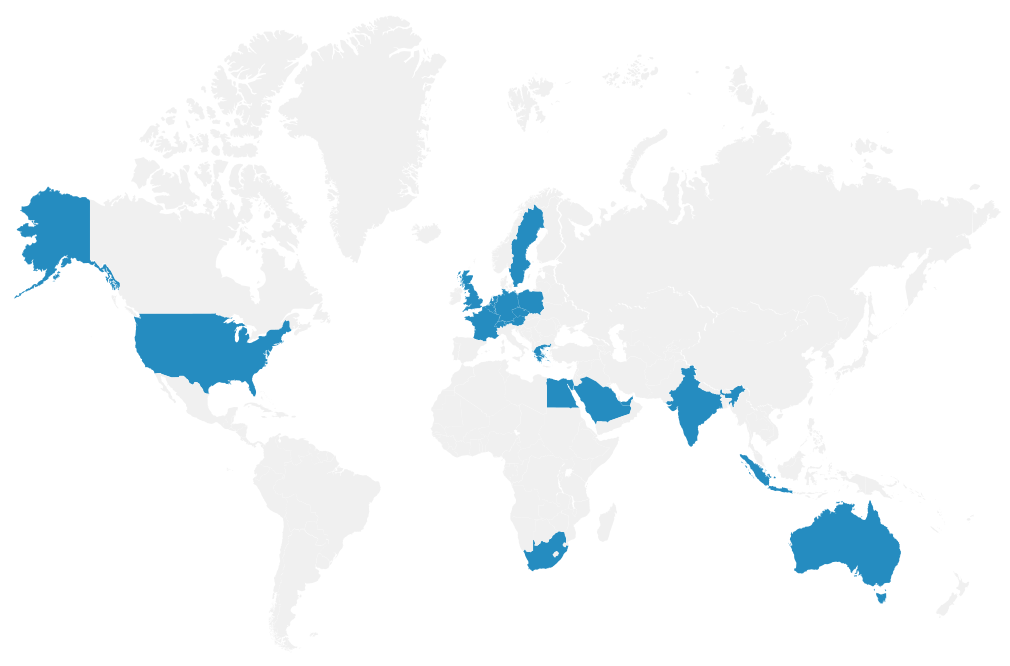
Cloudmaven in Figures
16+
Locations worldwide (Europe, EMEA, America, Asia)
30+
Countries in which we operate
120+
ERP and EPM employees
350+
satisfied customers
400+
Successfully implemented projects

Companies that already rely on our portfolio










eUnify, thought through from a finance perspective
A native NetSuite application, not a separate middleware tool bolted on beside it. Sales and finance work from one shared set of numbers.
Runs inside NetSuite It runs as an application inside NetSuite itself, so there’s no separate portal or login for the finance team to manage.
Deals become orders automatically Deals and quotes flow into NetSuite as sales orders or estimates the moment they close, instead of waiting for someone to key them in by hand.
Two-way contact sync Contact and company records stay in sync in both directions, so sales and finance are always looking at the same customer.
Full line item detail Product, pricing, and line item detail carries across with the deal, down to quantities and discounts.
Finance data where sales works NetSuite invoice status, payment terms, and order history show up on the HubSpot deal, without giving sales a NetSuite login.
Entity-specific routing Each legal entity keeps its own routing rules, so multi-subsidiary NetSuite setups don’t need a workaround.
Configurable sync rules Only the records you actually want (deals over a certain value, specific pipelines, qualified contacts) move between systems.
Real attribution for marketing Marketing gets real revenue and lifetime value data back in HubSpot, instead of guessing at campaign ROI from clicks and form fills.
Complete audit trail Full sync history and status tracking give both teams a clear record of what moved, when, and why.
Features
From first deal to final invoice, on one shared set of numbers. eUnify’s HubSpot connector is built around two data flows, delivered as a phased rollout: most engagements start with deal and contact sync, then add invoice and payment visibility once the sales side is running smoothly and mapping is confirmed.
Sales to finance: HubSpot deals into NetSuite Convert HubSpot deals and quotes into NetSuite sales orders or estimates automatically, carrying every line item, quantity, and discount with them. It supports deal-stage triggers such as Closed Won, contact and company sync (a prospect in HubSpot becomes a lead or prospect in NetSuite, a customer stays a customer), configurable sync rules by pipeline or deal value, and quote-to-order automation using real NetSuite pricing and product data.
Finance to sales: NetSuite data into HubSpot Bring NetSuite order history, invoice status, payment terms, and customer lifetime value back into HubSpot, so sales and marketing can act on real financial data. It supports invoice and payment status on deal and company records, order history and lifetime value for segmentation, shipping and fulfillment updates, and credit memo or refund visibility.
eUnify, a point connector, or building it yourself? An honest decision guide
Most companies arrive at this decision from one of three starting points. It’s worth naming them plainly instead of just comparing feature checklists.
Rather keep manual handoff
Company profile Small deal volume, one entity, still manageable by hand.
Data volume & entities Low deal volume, infrequent handoffs.
Finance visibility Manual review is still workable.
Time to value No implementation needed, but manual re-entry every week.
Reporting Spreadsheet reconciliation between systems.
Audit trail Email-based history, harder to reconstruct.
Rather a typical connector
Company profile Single-direction sync need, such as contacts only.
Data volume & entities Growing, but still a single entity.
Finance visibility Basic contact or deal sync covers it.
Time to value Faster to set up, narrower scope.
Reporting Basic reporting on synced records.
Audit trail Varies by vendor; visibility often one-directional.
Rather eUnify
Company profile Multi-subsidiary NetSuite, full quote-to-cash automation needed.
Data volume & entities Multiple legal entities, deals need entity-specific routing.
Finance visibility Full quote-to-order-to-invoice visibility across sales and finance.
Time to value Native NetSuite app; live sync once mapping is confirmed.
Reporting Real revenue attribution and lifetime value data inside HubSpot.
Audit trail Full sync history and status tracking, native to NetSuite.
In a joint discovery conversation , we assess your current HubSpot and NetSuite setup without pre-committing you to a solution, and recommend the sync scope that fits your pipeline structure, entity setup, and reporting needs.

We connect your relevant systems seamlessly
Cloudmaven connects eUnify to your existing system landscape: HubSpot CRM and marketing hub, NetSuite OneWorld across multiple subsidiaries, and any other Cloudmaven integrations you’re already running in NetSuite, such as Personio for HR data, Perk for travel and expense management, or the DATEV connector for German accounting and payroll.

Switching from an existing process
Typical starting points for a HubSpot to NetSuite integration project differ quite a bit in effort and risk, so it’s worth setting expectations upfront:
Source process
Manual exports between HubSpot and NetSuite
Typical migration effort
Low to medium
What matters most
Mapping existing deal stages, pipelines, and product records to NetSuite fields.
Source process
Native HubSpot workflow automation or a basic connector
Typical migration effort
Medium
What matters most
Migrating existing workflow triggers and field mappings without breaking live deals.
Source process
Another third-party middleware tool
Typical migration effort
Medium to high
What matters most
Migrating historical sync configuration and running a parallel period before cutover.
Cloudmaven & eUnify
Our principle holds for integration projects too: we start the conversation with your sales process and financial structure, not with the connector. Cloudmaven already supports complex, growing organisations as a NetSuite implementation partner across Switzerland, Germany, and beyond.
eUnify was developed in-house specifically to close the gap between HubSpot and NetSuite: the same team that configures your NetSuite finance architecture also owns the CRM connector, instead of handing you off to a third-party vendor once the ERP project is done.
Companies that already trust our portfolio
Our services
Requirement analysis and HubSpot to NetSuite mapping design
Deal, quote, and product sync configuration
Multi-subsidiary routing setup
Invoice and payment status sync back to HubSpot
Marketing attribution and revenue reporting setup
Ongoing support and monitoring
Our approach
Our approach is built on the Cloudmaven.ERP Methodology and its Target Operating Model (TOM) Framework.
What is the Cloudmaven Integration Rollout?
The implementation of eUnify’s HubSpot connector follows a structured, phase-based approach: a requirements and mapping workshop, sync rule and routing configuration, parallel testing against live deals, go-live, and a hypercare phase alongside the first full sales cycle.
Implementation typically takes two to six weeks, depending on how many pipelines, entities, and financial data points are in scope.
FAQs
What is eUnify’s HubSpot NetSuite integration?
eUnify is a native NetSuite application that automates data flow between HubSpot and NetSuite. It converts HubSpot deals and quotes into NetSuite sales orders or estimates, keeps contacts and companies in sync, and brings NetSuite order, invoice, and payment data back into HubSpot.
Does it sync in both directions?
Yes. Sales-side data such as deals, quotes, contacts, and companies flows from HubSpot into NetSuite, while finance-side data such as order status, invoices, payment terms, and lifetime value flows back into HubSpot.
Can we control which deals or contacts sync?
Yes. Sync rules can be filtered by pipeline, deal value, deal stage, or contact properties, so only the records you actually want move between systems.
Does it support quotes and product line items?
Yes. HubSpot quotes map to NetSuite estimates with full line item detail, including quantities, pricing, and discounts, using live NetSuite product data.
Can we see NetSuite invoice and payment data in HubSpot?
Yes. Invoice status, payment terms, and outstanding balances surface on the HubSpot deal or company record, so sales and customer success can see financial health without needing NetSuite access.
How does it handle multiple NetSuite subsidiaries?
Each legal entity keeps its own routing rules and account mappings, so deals are created against the correct subsidiary automatically.
Why not just use HubSpot’s native NetSuite connector or a generic iPaaS tool like Celigo or Boomi?
Generic connectors and iPaaS platforms are built to move data between any two systems in general. They don’t natively understand NetSuite’s subsidiary structure, tax logic, or accounting periods, and they typically live outside NetSuite as a separate tool with its own login. eUnify is purpose-built for NetSuite specifically, runs inside your NetSuite account, and is maintained by the same team that implements your NetSuite finance setup, so the entity routing, pricing, and tax handling stay consistent with the rest of your NetSuite configuration.
Where does eUnify run, and is our data secure?
eUnify runs natively inside the NetSuite account. Financial data stays in NetSuite, and only the fields you choose to sync move into HubSpot. Access is role-based, encrypted, and fully auditable.
How long does implementation take?
Because eUnify is a pre-built NetSuite application rather than a custom-built interface, most companies go from kickoff to a live sync in a few weeks, not months. Your Cloudmaven consultant will scope exact timelines based on how many pipelines, entities, and data points are involved.
Explore other tools for your business
If HR data also needs to flow into NetSuite, we support the Personio to NetSuite integration. For travel and expense management, the Perk platform integrates natively with NetSuite. For companies with a German entity, the DATEV connector automates accounting export and payroll import. For planning, budgeting, and consolidation we also offer Enterprise Performance Management (EPM), and AI process automation can take further manual effort out of your finance processes. All of these run on the same eUnify middleware underneath this connector.